Web DevelopmentJune 18, 2026
How to Build Autonomous AI Agents Using Python
Learn how to build autonomous AI agents using Python. Explore key components, development process, business applications, and the role of AI application development in modern automation.
Agix International
Agix International
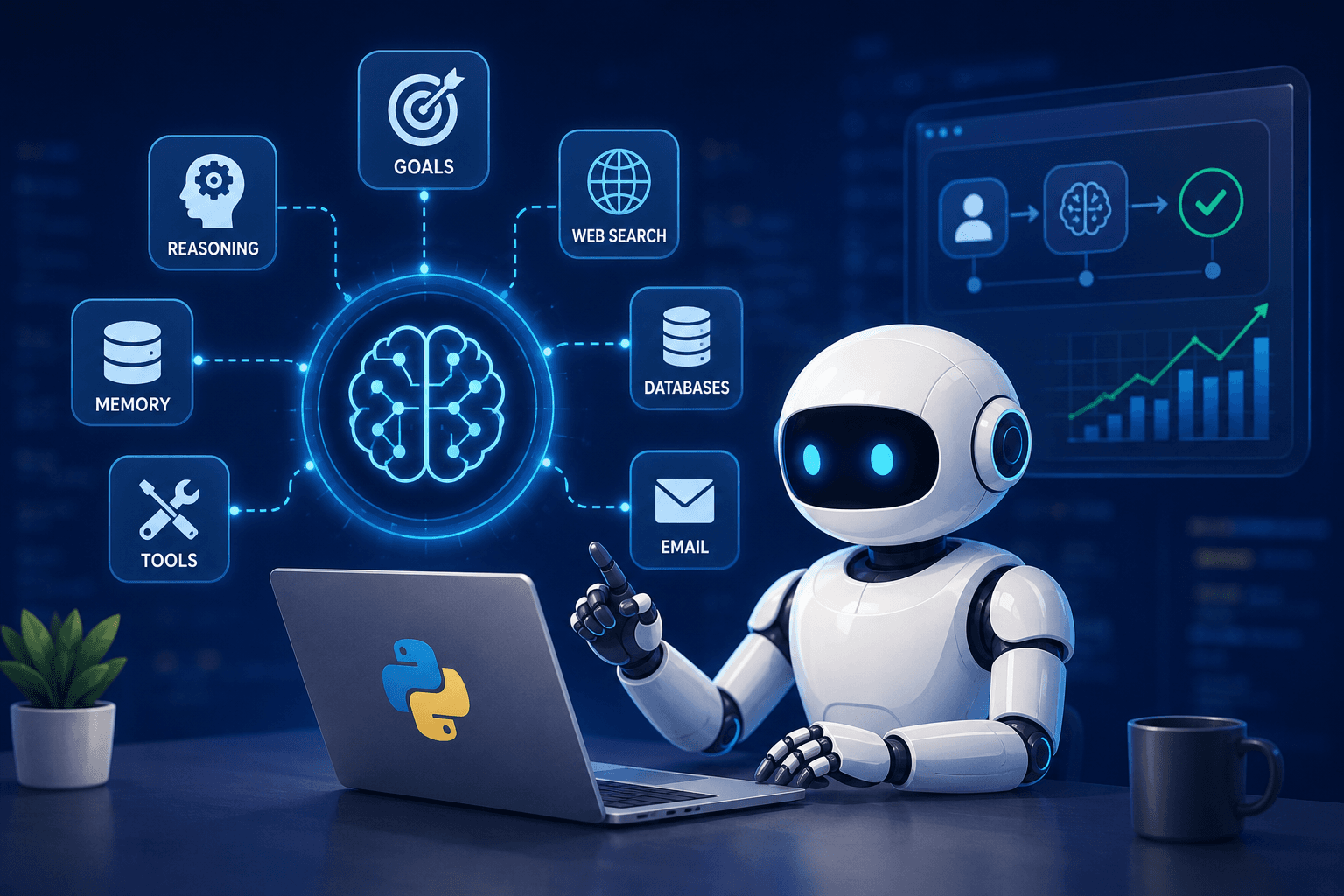
Artificial intelligence is moving beyond chatbots and simple automation tools. Modern systems can now make decisions, perform tasks, interact with applications, and work toward specific goals with minimal human intervention. These systems are known as autonomous AI agents.
Organizations across industries are investing in autonomous AI agents to improve productivity, reduce manual work, and automate complex processes. Python has become the preferred programming language for building these intelligent systems due to its flexibility, extensive libraries, and strong support for artificial intelligence technologies.
This article explains how autonomous AI agents work, why Python is widely used for their development, and how businesses can benefit from this growing technology.
What are autonomous AI agents?
An autonomous AI agent is a software system that can perceive information, analyze situations, make decisions, and take actions to achieve a defined objective.
Unlike traditional automation tools that follow fixed rules, autonomous agents can adapt their actions based on changing conditions and available information.
For example, an AI agent designed for customer support can:
- Read incoming customer messages
- Understand the issue
- Search company knowledge bases
- Generate a suitable response
- Escalate complex cases when necessary
The entire process can happen with minimal human involvement.
Why Python is the preferred choice
Python AI development continues to dominate the artificial intelligence industry because of its simplicity and extensive ecosystem. Developers can access powerful libraries and frameworks that simplify complex AI tasks.
Popular Python tools include:
- LangChain
- LlamaIndex
- Transformers
- FastAPI
- Pandas
- NumPy
- CrewAI
- LangGraph
These frameworks help developers build, test, and deploy autonomous agents faster while maintaining scalability and performance.
Core components of an autonomous AI agent
Successful AI agents typically consist of several key components.
Goal management
Every agent requires a defined objective. The goal acts as the foundation for all decision making and actions.
Examples include:
- Answer customer queries
- Analyze market trends
- Generate reports
- Schedule appointments
- Monitor business performance
Reasoning engine
The reasoning engine evaluates available information and determines the next action.
It helps the agent decide:
- What information is needed
- Which task should be completed first
- How to respond to changing conditions
Memory system
Memory allows agents to store and retrieve information. Short term memory helps manage active tasks and conversations. Long term memory stores historical interactions, preferences, and business knowledge that can improve future decisions.
Tool integration
Autonomous agents become more powerful when connected to external systems.
Common integrations include:
- Databases
- Email platforms
- CRM software
- Business applications
- Document repositories
- Search engines
These integrations allow agents to perform actions rather than simply generating responses.
Development process for autonomous AI agents
Building an autonomous AI agent involves several stages.
Define the objective
Start by identifying the business problem that the agent will solve. A clearly defined objective helps establish success criteria and development priorities.
Select the technology stack
A common stack includes:
- Python
- FastAPI
- PostgreSQL or MongoDB
- Large Language Models
- Vector databases
This combination supports scalability and efficient data processing.
Implement memory and context
Context awareness is critical for autonomous systems. Agents should be able to remember previous interactions and use historical information when making decisions.
Connect external tools
The next step is integrating applications, APIs, and databases that support task execution. This enables agents to perform real business activities rather than simply providing information.
Test and optimize
Continuous testing helps improve decision accuracy, response quality, and operational efficiency. Performance monitoring is essential before deploying agents into production environments.
Business applications of autonomous AI agents
Organizations are adopting autonomous AI agents across multiple departments.
Customer support
Agents can handle inquiries, resolve common issues, and provide instant responses around the clock.
Sales and lead management
AI agents can qualify leads, schedule meetings, and maintain communication with prospects.
Market research
Agents can collect data, analyze survey responses, identify trends, and generate business insights.
Human resources
AI agents can assist with candidate screening, on boarding activities, and employee support.
Operations management
Organizations use autonomous agents to monitor workflows, identify bottlenecks, and improve efficiency.
The role of AI development companies
Many businesses partner with an AI development company to accelerate implementation.
An experienced development partner can help:
- Define business requirements
- Design system architecture
- Develop custom AI agents
- Integrate enterprise applications
- Ensure security and compliance
- Deploy and maintain solutions
This approach reduces development risks and shortens implementation timelines.
Future of autonomous AI agents
Autonomous AI agents are expected to become a standard component of modern business operations. As language models, reasoning capabilities, and enterprise integrations continue to improve, agents will handle increasingly complex workflows across industries.
Businesses investing in AI application development today are building systems that can automate tasks, improve decision making, and support long term growth.
Conclusion
Building autonomous AI agents using Python provides organizations with a practical way to automate processes and improve operational efficiency. Python offers the tools, frameworks, and flexibility required to create intelligent systems capable of working independently toward business goals.
As demand for automation continues to increase, Python AI development and AI application development will remain central to the next generation of intelligent business solutions. Working with an experienced AI development company can help organizations implement these technologies effectively and achieve measurable results.