Web DevelopmentOctober 15, 2026
DevSecOps: A Practical Guide to Secure Software Delivery
A practical DevSecOps guide: what changes from DevOps, the controls at each pipeline stage, supply chain security, policy as code, and a phased rollout plan.
Agix International
Agix International
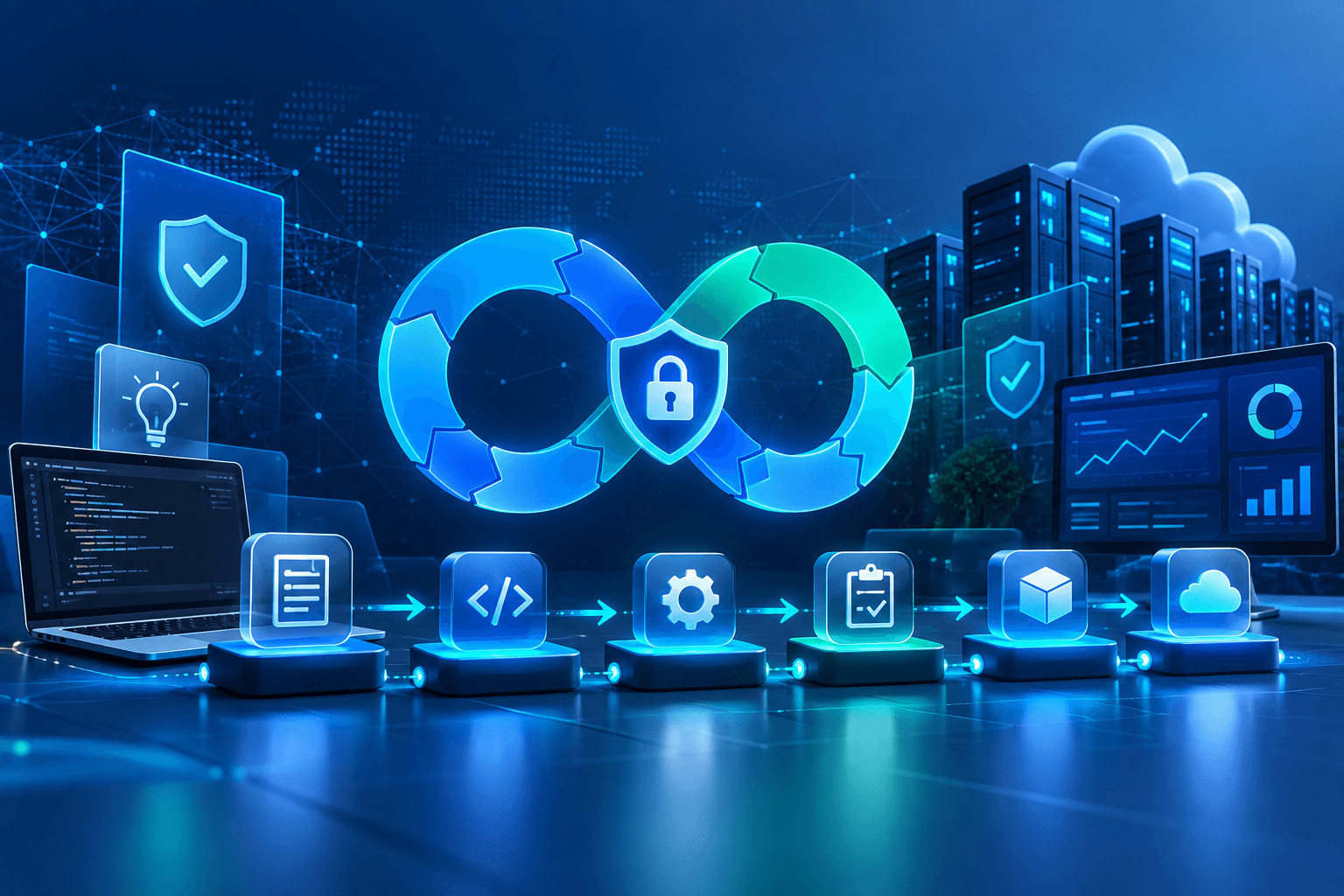
DevSecOps is the practice of building security checks into every stage of software delivery, from planning and coding through build, release, and production, so the teams that ship code also own its security. Done well, it finds most problems while they are still cheap to fix, without turning every release into a security review.
Most engineering teams already have some security tooling. A dependency scanner runs somewhere. A penetration test happens once a year. What they usually lack is a system: clear rules for which check runs where, which findings stop a release, and who fixes what by when. That system is what DevSecOps provides.
This guide is written for the people who have to build it. It covers the controls at each pipeline stage, how to keep scanners from burying your developers in noise, how to secure the build system itself, and how to roll the whole thing out in phases without stalling delivery.
What Is DevSecOps?
DevSecOps extends DevOps with one idea: security is a shared responsibility, enforced by automation, and checked continuously rather than at the end. Security specialists still exist, but their job shifts from reviewing every release to designing guardrails, writing policies, and helping teams fix what the pipeline finds.
DevOps vs. DevSecOps: What Actually Changes
DevOps joined development and operations so teams could release often and recover quickly. DevSecOps keeps that speed and adds security gates to the same pipeline. The tools change less than the ownership does: a developer who introduces a vulnerable library is the person who gets the alert and fixes it. We cover the differences in detail in DevOps vs. DevSecOps: The Practical Differences.
Why Traditional Application Security Broke under Continuous Delivery
The old model assumed a few releases a year and a security team that tested each one before launch. When teams deploy several times a week, that model creates a queue. Releases either wait for security or skip it. Neither is acceptable, so the checks have to move into the pipeline and run on every change.
The DevSecOps Life Cycle, Stage by Stage
The table below is a reference design. Not every team needs every control on day one, but every control has a natural home.
| Stage | Main controls | Common open-source or platform tools | Blocks the build? |
|---|---|---|---|
| Plan | Threat modeling, security requirements | OWASP Threat Dragon, design reviews | No |
| Code | Pre-commit secret scanning, IDE linting, secure defaults | Gitleaks, Semgrep | Secrets: yes |
| Build | Software composition analysis (SCA), SBOM generation, provenance | Trivy, Syft, Grype | Critical, reachable issues: yes |
| Test | Static (SAST) and dynamic (DAST) application testing | Semgrep, ZAP | High-confidence findings only |
| Release | Artifact signing, admission control | Sigstore cosign, Kyverno | Unsigned artifacts: yes |
| Deploy | Infrastructure as code (IaC) scanning, configuration baselines | Checkov, Trivy | Policy violations: yes |
| Operate | Runtime detection, cloud security posture management | Falco, cloud-native CSPM | No (alerts and tickets) |
A few notes on the testing types, because they are often confused. SAST reads source code and finds patterns such as injection flaws. DAST attacks a running application from the outside. SCA inventories third-party packages and matches them against known vulnerabilities. Interactive testing (IAST) instruments the running application to combine both views. Each catches problems the others miss, which is why mature pipelines run more than one.
Beyond Shift Left: Prioritize by Context
"Shift left" means moving security checks earlier in the life cycle. It was the right correction, but teams that applied it literally ran every scanner on every commit and drowned in findings. A typical service has hundreds of dependencies, and many carry known vulnerabilities that the application never actually calls.
Context-driven prioritization fixes this. Instead of ranking findings by severity score alone, rank them by three questions:
- Is the vulnerable code reachable? If your application never calls the affected function, the risk is far lower.
- Is it likely to be exploited? The Exploit Prediction Scoring System (EPSS), overseen by FIRST, estimates the probability that a vulnerability will be exploited in the wild within the next thirty days. The CISA Known Exploited Vulnerabilities catalog lists vulnerabilities already under active attack.
- Is it exposed? An internet-facing service matters more than an internal batch job.
A critical-severity finding that fails all three tests can wait for the next sprint. A medium-severity finding in an exposed, reachable path with an active exploit should stop the release.
Securing the Software Supply Chain
Your pipeline builds software from code you wrote, code you downloaded, and tools you trust. Attackers increasingly target the last two.
Software Bills of Materials
An SBOM is an inventory of every component in a build, including transitive dependencies. The two dominant formats are SPDX, published as the international standard ISO/IEC 5962:2021, and OWASP CycloneDX. Generate the SBOM at build time, not after the fact, and store it next to the artifact it describes. When the next widely exploited library flaw appears, you can answer "are we affected?" in minutes rather than days.
Build Provenance and SLSA
The SLSA framework defines build levels that describe how much you can trust an artifact's origin. At Build L1, provenance exists that describes how the artifact was built. At Build L2, the build runs on a hosted platform and the provenance is digitally signed by that platform. At Build L3, the platform is hardened so that builds cannot influence one another and signing secrets are kept away from user-defined build steps. Teams that already use a hosted CI service can often reach L2 with its built-in provenance and attestation features.
Hardening the CI/CD System Itself
The pipeline holds production credentials, so it is a target in its own right. The essentials:
- Replace long-lived cloud keys with short-lived credentials issued through OpenID Connect (OIDC) federation.
- Give each workflow the minimum permissions it needs, and scope tokens per job.
- Isolate build runners so one job cannot read another's secrets or workspace.
- Require review for changes to pipeline definitions, just as you do for application code.
- Pin third-party actions and plug-ins to specific versions or commit hashes.
Policy as Code and Automated Enforcement
Written security policies that live in a wiki do not enforce themselves. Policy as code turns rules such as "no container runs as root" or "every image must be signed" into machine-checked tests. Open Policy Agent (OPA), with its Rego language, and Kyverno, which works natively in Kubernetes, are the common choices.
The harder decision is which rules block a deployment and which only warn. A practical rule: block on anything that is high-confidence and cheap to fix (exposed secrets, unsigned images, public storage buckets), and warn on anything that needs judgment. Every blocking rule also needs a documented exception path with an owner and an expiry date. Without one, teams will route around the gate.
Compliance Mapping for India and the GCC
Most DevSecOps content assumes US or EU regulation. Teams in India and the Gulf face additional, specific obligations, and a well-built pipeline produces much of the evidence they require.
| Regulation | Key requirement for engineering teams | How the pipeline helps |
|---|---|---|
| CERT-In Directions (April 28, 2022) | Report specified cyber incidents within six hours; keep system logs for a rolling 180 days within Indian jurisdiction; sync clocks to NIC or NPL time servers | Centralized, time-synced logging and runtime detection |
| India's Digital Personal Data Protection Act, 2023 | Reasonable security safeguards for personal data; the DPDP Rules, 2025 were notified on November 14, 2025, with an eighteen-month phased compliance period | Data-flow mapping in threat models, secrets control, access logs |
| UAE Federal Decree-Law No. 45 of 2021 (Personal Data Protection Law) | Protection of personal data processed in the UAE | Same controls, plus data-residency checks in IaC policies |
| EU Cyber Resilience Act (for products sold in the EU) | Reporting obligations apply from September 11, 2026; main obligations from December 11, 2027 | SBOMs, vulnerability handling records, signed releases |
The DPDP penalties are not trivial: failing to maintain reasonable security safeguards can draw a penalty of up to ₹250 crore. Frameworks such as ISO/IEC 27001 and SOC 2 ask for similar evidence. When scan results, approvals, and SBOMs are stored automatically with each release, audit preparation becomes an export rather than a project.
A Phased DevSecOps Adoption Roadmap
Teams that switch on every gate at once usually switch them off again within a month. A phased approach works better.
- Phase 1: Visibility without blocking. Run secret scanning, SCA, and SAST on every pull request, but report only. Measure the volume and quality of findings for a few weeks.
- Phase 2: Selective gating. Block on exposed secrets and on critical vulnerabilities that are reachable or known to be exploited. Tune or remove noisy rules.
- Phase 3: Policy as code and supply chain controls. Add SBOM generation, artifact signing, admission control, and IaC policies.
- Phase 4: Runtime feedback. Feed production detections and incident findings back into threat models, test cases, and pipeline rules.
Small teams without a dedicated security engineer can still follow this path. The first two phases rely almost entirely on open-source tools and need more discipline than budget.
Metrics That Show DevSecOps Is Working
Count outcomes, not scans. Useful measures include mean time to remediate vulnerabilities by severity, the age of your oldest open critical finding, the share of releases shipped with an SBOM and signature, and the escape rate: issues found in production that the pipeline should have caught. A falling escape rate is the clearest sign that the system works.
Common DevSecOps Mistakes
- Buying a platform before deciding which findings should block a release.
- Treating every critical CVSS score as an emergency.
- Securing the application while leaving the CI system full of long-lived secrets.
- Making exceptions permanent by never giving them an expiry date.
- Measuring success by the number of tools deployed.
Frequently Asked Questions
What Is DevSecOps in Simple Terms?
DevSecOps means that security checks run automatically inside the same pipeline that builds and deploys software, and that developers own the fixes. Security becomes a continuous part of delivery rather than a final review.
Is DevSecOps a Role or a Practice?
It is primarily a practice. Some companies hire DevSecOps engineers to build the tooling, but the model only works when every development team takes responsibility for the security of what it ships.
What Tools Are Used in DevSecOps?
Typical stacks combine secret scanners, SAST, SCA, DAST, SBOM generators, artifact signing, policy engines such as OPA or Kyverno, IaC scanners, and runtime detection. Many strong options are open source.
What Is an SBOM, and Is It Mandatory?
An SBOM is a machine-readable inventory of a software build's components. It is increasingly expected by enterprise and government buyers, and the EU Cyber Resilience Act brings formal vulnerability-handling duties for products sold in the EU.
How Long Does DevSecOps Adoption Take?
It depends on the number of services and the current state of the pipeline. A phased rollout lets a team gain visibility within weeks, then add blocking gates and supply chain controls over the following months.
Build Your Pipeline with Agix
Agix International designs and builds cloud, DevOps, and cybersecurity foundations for startups, SMEs, and enterprises across India and the GCC. If you want a clear view of where your pipeline stands and what to fix first, book a consultation. We scope requirements, timeline, and a fixed-price proposal within forty-eight hours.