AI & TechnologySeptember 28, 2026
Multi-Agent AI Systems: How Collaborative AI Agents Solve Complex Problems
Learn how multi-agent AI systems split complex work across specialised AI agents, where they help businesses, where they fail and when one agent is enough.
Agix International
Agix International
Give one AI model a simple job, like summarising a contract or answering a refund question, and it will usually do fine. Give it something messy, like reviewing 400 supplier contracts, flagging risky clauses, checking each one against your procurement policy and drafting a report for the CFO, and it starts to slip. It loses track of earlier details. It skips steps. It marks its own homework and gives itself full marks.
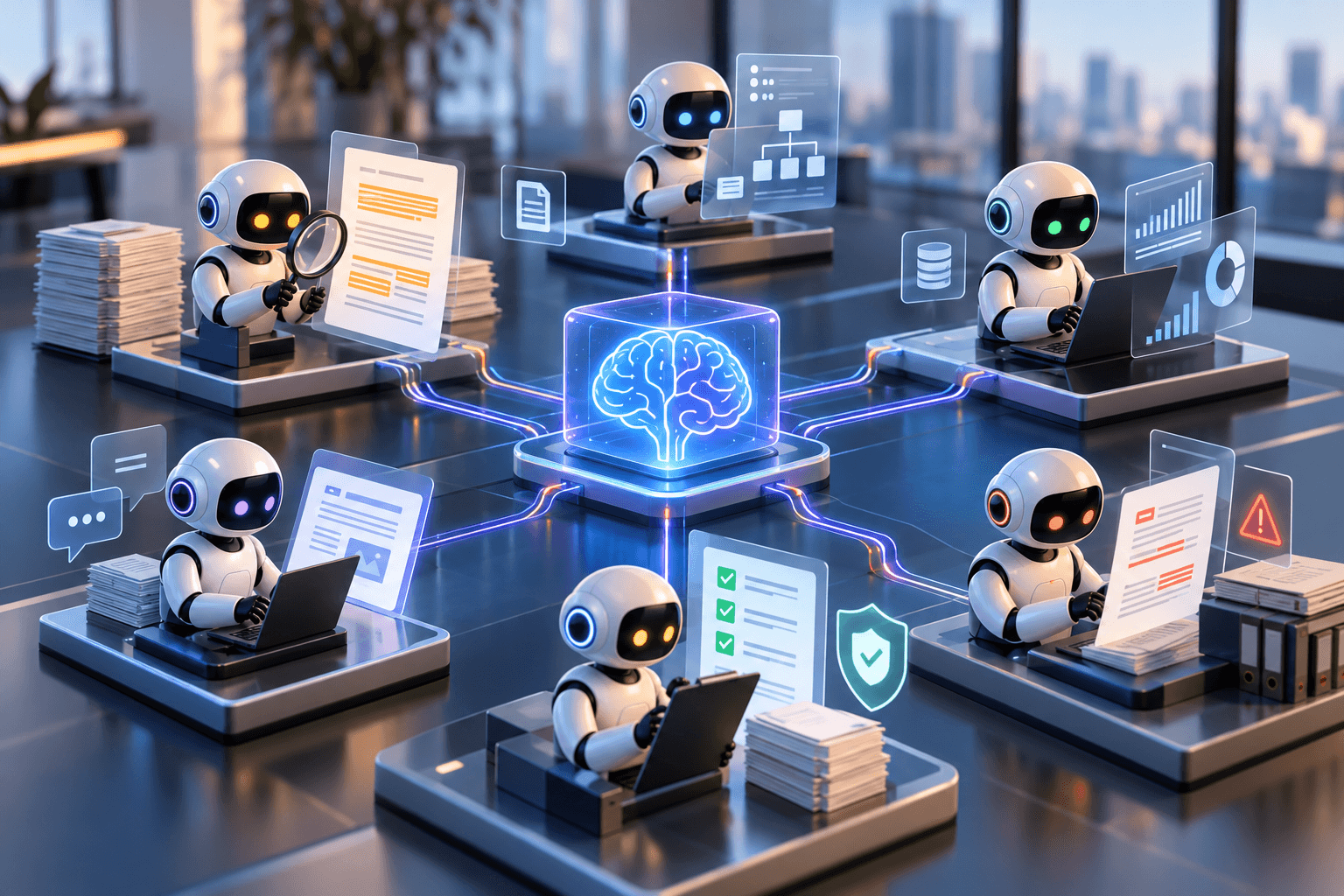
People have the same problem, which is why we don't ask one person to run a whole department. We split the work. Multi-agent AI systems bring that same idea to software: several AI agents, each with a clear job, working together on a problem that is too big or too varied for one agent to handle well.
This article is part of our series on AI agents for business. If you're new to the topic, start with our complete guide to AI agents and come back here. Below, we look at how multi-agent systems are built, where they actually help, where they fall apart, and how to decide whether you need one.
What is a multi-agent AI system?
An AI agent is a language model that can do more than chat. It gets a goal, has access to tools (a search engine, a database, an email account, a code runner) and decides for itself which step to take next. It looks at the result of each step and adjusts.
A multi-agent system puts several of these agents together. Each one gets its own role, its own instructions and often its own tools. One might pull data from your CRM. Another might analyse it. A third might write the summary, and a fourth might check that summary against the source numbers before anyone sees it.
The difference from a single agent isn't just "more AI". It's division of labour. Each agent only holds the context for its own piece of the job, so it isn't juggling everything at once. That matters because language models can only hold so much text at a time, and their output tends to get worse as that space fills up with loosely related material.
Two open standards have made these systems easier to build. The Model Context Protocol (MCP), released by Anthropic in November 2024, gives agents a common way to connect to tools and data. Google's Agent2Agent protocol (A2A), announced in April 2025, gives agents built by different vendors a common way to talk to each other.
How AI agents work together: four common patterns
1. Orchestrator and workers
A lead agent breaks the job into parts, hands each part to a worker agent, then pulls the results together. This is the most common setup. It suits work that splits cleanly into independent pieces, such as researching ten competitors at the same time.
2. Sequential pipeline
Agents work like an assembly line. Agent A reads invoices and extracts the data, Agent B validates it, and Agent C posts it to the ledger. Each hand-off is predictable, which makes this pattern easy to test and audit.
3. Maker and checker
One agent produces something and another reviews it. A coding agent writes a function; a reviewer agent runs the tests and sends it back with notes. Banks have used the maker-checker rule for decades for the same reason: the person who does the work shouldn't be the one who approves it.
4. Debate or panel
Several agents tackle the same question separately, then compare answers before a final agent decides. It costs more, but it can catch mistakes that a single line of reasoning would miss. That makes it worth considering for high-stakes judgement calls.
Most real systems mix these. A research tool might use an orchestrator to farm out searches, then a checker to verify every citation before the report goes out.
Multi-agent AI results: what the evidence says
The clearest public example comes from Anthropic, which described the setup behind Claude's Research feature in June 2025. A lead agent plans the research, starts several sub-agents that search in parallel (each with its own context window), and then combines what they find. On Anthropic's internal research evaluation, this setup, with Claude Opus 4 leading and Claude Sonnet 4 sub-agents doing the searching, beat a single Claude Opus 4 agent by 90.2%.
It did best on breadth-first questions, where the answer means looking in many directions at once. Anthropic's example was finding the board members of every IT company in the S&P 500. A single agent working through that list one company at a time is slow and loses the thread. Parallel agents don't have that problem.
The same write-up is candid about the cost. Multi-agent systems used roughly 15 times more tokens than a normal chat. Token usage on its own explained about 80% of the variation in performance on Anthropic's browsing test, so a good share of the gain comes from spending more compute on the problem. Anthropic also noted that tasks where every agent needs the same shared context, or where steps depend heavily on each other, are a poor fit for multi-agent designs today.
Where multi-agent systems help businesses
The approach works best where a job already involves several specialists passing work to each other. A few examples:
- Customer support. A triage agent reads the ticket and routes it. A billing agent checks the account, a policy agent checks what the customer is entitled to, and a drafting agent writes the reply. Anything unusual goes to a person.
- Finance operations. One agent extracts invoice data, another matches it against purchase orders, and a third flags mismatches for the accounts team.
- Market and competitor research. An orchestrator sends workers to cover pricing, product changes, hiring and news for each competitor, then compiles one brief.
- Software delivery. Separate agents write code, write tests, review changes and update documentation, with a developer approving the final merge.
- Compliance review. One agent pulls clauses from contracts, another compares them with internal rules, and a checker confirms that every flagged item points to a real clause rather than an invented one.
What these have in common is that each agent's job is narrow enough to describe in a paragraph and to check against a clear standard. If you can't describe the job that clearly, splitting it across agents usually makes things worse, not better.
Where multi-agent systems go wrong
More agents means more hand-offs, and every hand-off is a chance for something to get lost. Researchers at UC Berkeley studied this in a paper called "Why Do Multi-Agent LLM Systems Fail?", presented at NeurIPS 2025. They collected more than 1,600 annotated execution traces from seven popular multi-agent frameworks and found 14 distinct ways these systems break, which fall into three groups:
- Specification problems. The task or the roles were badly defined, so agents misread the goal, step outside their role or stop before the job is done.
- Misalignment between agents. Agents talk past each other, ignore a colleague's input or lose important details during a hand-off.
- Weak verification. Nobody checks the output properly, or the checker confirms that something was produced without confirming it's right.
The takeaway for anyone planning a project is that many of these failures come from how the system is designed, not from a weak model. A smarter model won't fix a vague brief or a missing review step.
Cost and control are the other risk. In June 2025, Gartner predicted that more than 40% of agentic AI projects will be cancelled by the end of 2027 because of rising costs, unclear business value or poor risk controls. Multi-agent systems, with bigger compute bills and more moving parts, are exposed to all three.
One agent or many? A quick way to decide
Before building a multi-agent system, ask a few blunt questions:
- Does the work split into parts that can run on their own? If yes, parallel agents can save real time. If every step depends on the one before it, a single agent with good tools is often the better choice.
- Is the result worth the extra cost? A system that burns many times more compute has to earn it through hours saved, errors caught or revenue won.
- Can you write down each agent's job and how you'll check it? If not, sort out the process first.
- Where does a person step in? Decide which decisions need human sign-off, and log every action so you can trace what happened when something goes wrong.
Our advice is to start small. Get one agent working reliably on one well-defined task. Add a second agent when you hit a clear limit, such as a review step the first agent can't do well on its own work. Build up from there.
At Agix International, we design and build AI systems, including multi-agent workflows, for startups, SMEs and enterprises. If you're wondering whether a multi-agent approach fits a problem in your business, talk to our team. For the bigger picture, from single assistants to fully automated workflows, read our complete guide to AI agents.
Frequently asked questions
What is a multi-agent AI system?
It's a setup where several AI agents work together on one task, each with its own role and tools. One agent might gather data, another might analyse it, and a third might check the result before anyone sees it.
How is a multi-agent system different from a single AI agent?
A single agent handles every step on its own. A multi-agent system splits the work, so each agent only holds the context for its own part of the job. That helps on large tasks, where one agent tends to lose track of earlier details.
Are multi-agent AI systems more expensive to run?
Usually, yes. In Anthropic's research system, multi-agent runs used about 15 times more tokens than a normal chat. They're worth it when the result saves enough time or catches enough errors to cover that cost.
When should a business use multiple AI agents instead of one?
When the work splits into parts that can run on their own, each part is easy to describe and check, and the outcome is valuable enough to justify the extra compute. If every step depends on the one before it, a single agent with good tools is often the better choice.
What are the most common reasons multi-agent systems fail?
A UC Berkeley study of more than 1,600 execution traces sorted the failures into three groups: poorly defined tasks or roles, agents that miscommunicate or lose details during hand-offs, and weak checking of the final output. Most of these come from how the system is designed, not from the AI model itself.
Do multi-agent systems replace human workers?
In well-designed systems, no. People still set the goals, approve important decisions and handle unusual cases. The agents take on the repetitive steps in between, and every action should be logged so a person can review it.