AI & TechnologyOctober 26, 2026
AI Agents vs. Chatbots vs. Copilots vs. RPA Bots Compared
AI agents, chatbots, copilots, and RPA bots compared: who decides, what each can do, where each fits, and how to tell a real agent from a rebranded tool.
Agix International
Agix International
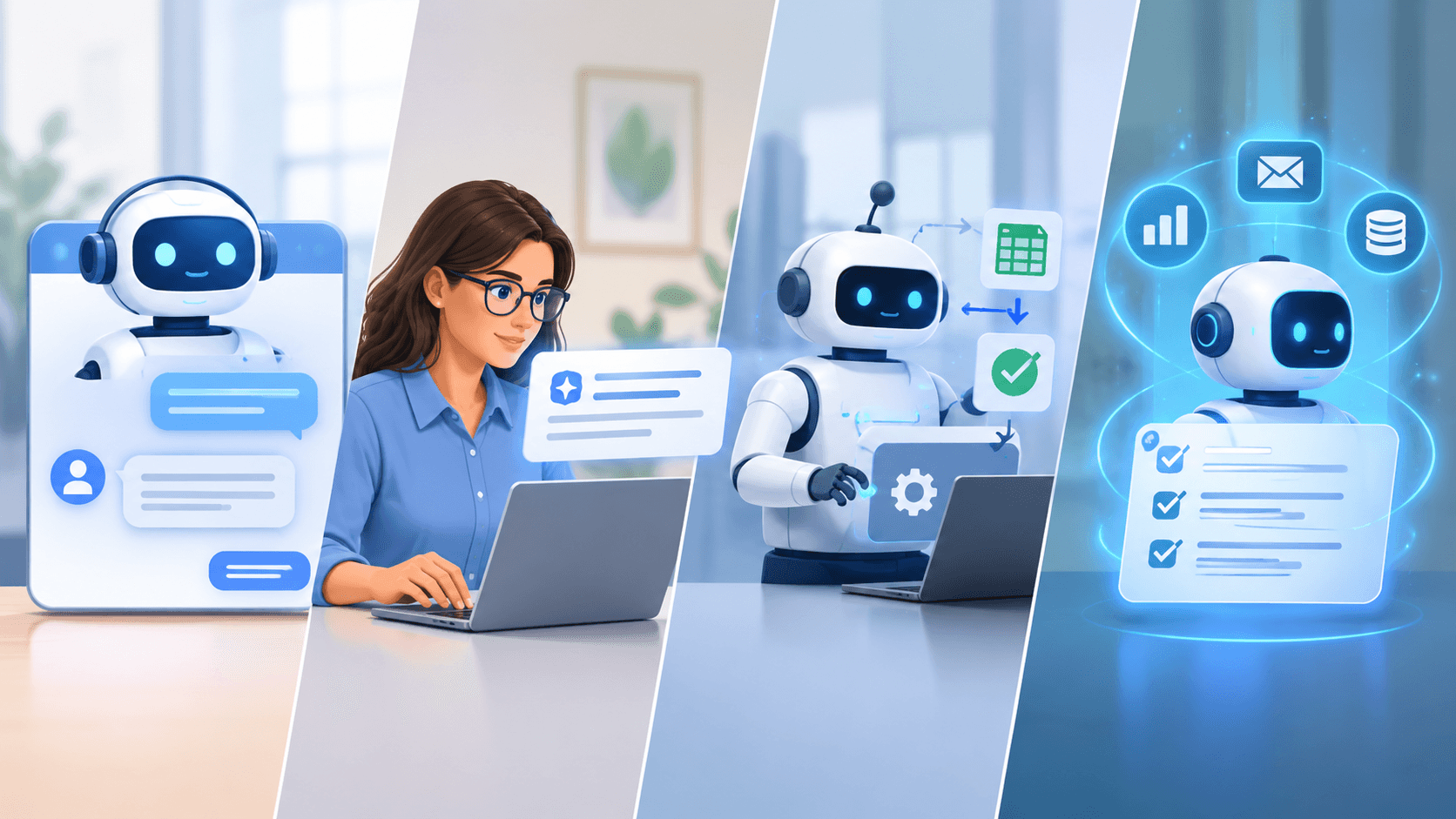
A chatbot answers questions in conversation. A copilot assists a person inside their tools, while the person decides and acts. An RPA bot follows fixed rules to repeat tasks in software. An AI agent pursues a goal by planning its own steps and using tools to act. The key differences are who decides the next step and whether the system takes actions.
Vendors now use these four terms loosely, and often interchangeably. That makes buying decisions harder than they should be. A team that needs a rules-based bot may end up paying for an "agent," and a team that needs an agent may be sold a chatbot with a new label.
This article defines each type clearly, compares them side by side, and offers a practical way to choose. For a deeper look at how agents work, see our guide to agentic AI.
The Four Types, Defined
Chatbots
A chatbot carries on a conversation, usually to answer questions or guide a user through a simple flow. Older chatbots followed scripted decision trees. Modern ones use large language models and retrieval from a knowledge base to give more natural answers. Many chatbots inform rather than act: they tell a customer how to reset a password, but they do not reset it.
Copilots
A copilot is an AI assistant built into a tool that a person is already using, such as an email client, a code editor, or a CRM. It drafts, summarizes, suggests, and explains. The defining feature is that a human stays in control: the copilot proposes, and the person accepts, edits, or rejects.
RPA Bots
Robotic process automation (RPA) bots follow predefined rules to perform repetitive tasks in software, such as copying data between systems or filling forms. They are deterministic: given the same input, they do the same thing every time. They are excellent for stable, structured work and poor at anything ambiguous.
AI Agents
An AI agent is given a goal rather than a script. It uses a language model to plan steps, calls tools such as APIs or databases to gather information and take actions, checks the results, and adjusts its plan. An agent asked to resolve a delivery complaint might look up the order, check the courier's status, issue a partial refund within its permitted limit, and write to the customer, choosing the sequence itself.
Side-by-Side Comparison
| Dimension | Chatbot | Copilot | RPA bot | AI agent |
|---|---|---|---|---|
| Main job | Answer and guide | Assist a person | Repeat rule-based tasks | Achieve a goal |
| Who decides the next step | Script or model, within a conversation | The human | The predefined rules | The agent, within limits |
| Takes actions in systems | Rarely | Usually only when the human approves | Yes | Yes |
| Handles unstructured input | Yes, in conversation | Yes | Poorly | Yes |
| Predictability | Medium | High, because the human decides | Very high | Lower; needs guardrails |
| Best for | Customer FAQs, self-service | Knowledge work, drafting, analysis | Stable, high-volume, structured tasks | Multistep tasks that need judgment |
| Main risk | Wrong or outdated answers | Over-reliance on suggestions | Breaks when screens or rules change | Wrong actions, cost overruns, security exposure |
Think in Levels of Autonomy
It helps to place these tools on a scale of autonomy rather than treat them as separate categories.
- Suggest: the system recommends, and a person acts. Most copilots sit here.
- Act with approval: the system prepares an action, and a person approves it before it runs.
- Act within limits: the system acts on its own inside defined boundaries, such as refunds below a set amount, and escalates the rest.
- Act and report: the system acts autonomously and humans review outcomes after the fact.
RPA bots operate at high autonomy but with no judgment, because their rules are fixed in advance. Agents can reach the same levels with judgment, which is exactly why they need clear limits. A sensible default is to start agents at level 2 and move up only as measured accuracy justifies it.
Beware of "Agent Washing"
In June 2025, Gartner warned about "agent washing," the rebranding of existing products, such as AI assistants, RPA, and chatbots, as agents without real agentic capabilities. It estimated that only about 130 of the thousands of vendors claiming agentic AI offered genuine agentic capabilities.
To test a product's claims, ask four questions:
- Can it plan a sequence of steps that was not scripted in advance?
- Can it call tools and act on the results?
- Can it recover when a step fails or returns something unexpected?
- Can you set and enforce limits on what it is allowed to do?
If the answer to the first three is no, it is probably a chatbot, a copilot, or a workflow with a language model attached. That may still be exactly what you need, but it should be priced and governed accordingly.
How to Choose
Start from the work, not the technology.
- The task is a question someone asks repeatedly: use a chatbot, connected to an accurate knowledge base.
- A skilled person does the work and needs to go faster: use a copilot.
- The steps are fixed, structured, and stable: use an RPA bot, or better, an API integration.
- The steps vary, the input is messy, and the task needs decisions across several systems: consider an agent, with guardrails and human checkpoints.
When in doubt, choose the most predictable option that solves the problem. A deterministic workflow is cheaper to run, easier to test, and simpler to audit than an agent. Our article on why AI agents fail in production explains what goes wrong when agents are used for work that did not need them.
They Work Best Together
In a well-designed customer service operation, all four may appear in the same journey. A chatbot handles the first conversation and answers routine questions. When a case needs action, an agent investigates across the order, payment, and shipping systems and proposes a resolution. An RPA bot carries out a step in a legacy billing system that has no API. If the case is escalated, a copilot helps the human support representative summarize the history and draft a reply.
The skill is in drawing the boundaries: which steps are deterministic, which need judgment, and where a person must approve. That is the core of hyperautomation, and for complex cases it can extend to multi-agent systems.
Frequently Asked Questions
Is a Chatbot an AI Agent?
Not usually. A chatbot converses and informs. It becomes agent-like only when it can plan steps and take actions in other systems toward a goal.
What Is the Difference between a Copilot and an AI Agent?
A copilot assists a person who stays in control of each decision. An agent can decide and act on its own within the limits it has been given.
Do AI Agents Replace RPA?
Not entirely. Agents handle variable, judgment-based work. RPA remains useful for deterministic tasks, especially in systems without APIs. Many automation estates will combine both.
Which Is Cheapest to Run?
Generally, RPA bots and scripted chatbots cost the least per task because they do not call large language models for every step. Agents cost more to run and need more monitoring, so they should be reserved for tasks where their flexibility adds value.
Find the Right Fit with Agix
Agix International builds AI chatbots, AI agents, and automation systems for businesses in India and the GCC. If you are deciding which approach fits your workflow, talk to our team.