AI & TechnologyOctober 22, 2026
Hyperautomation vs. RPA: What Changes When You Go End-to-End
Hyperautomation vs. RPA explained: scope, technologies, exceptions, and governance, with an invoice example and a plan to evolve an existing bot estate.
Agix International
Agix International
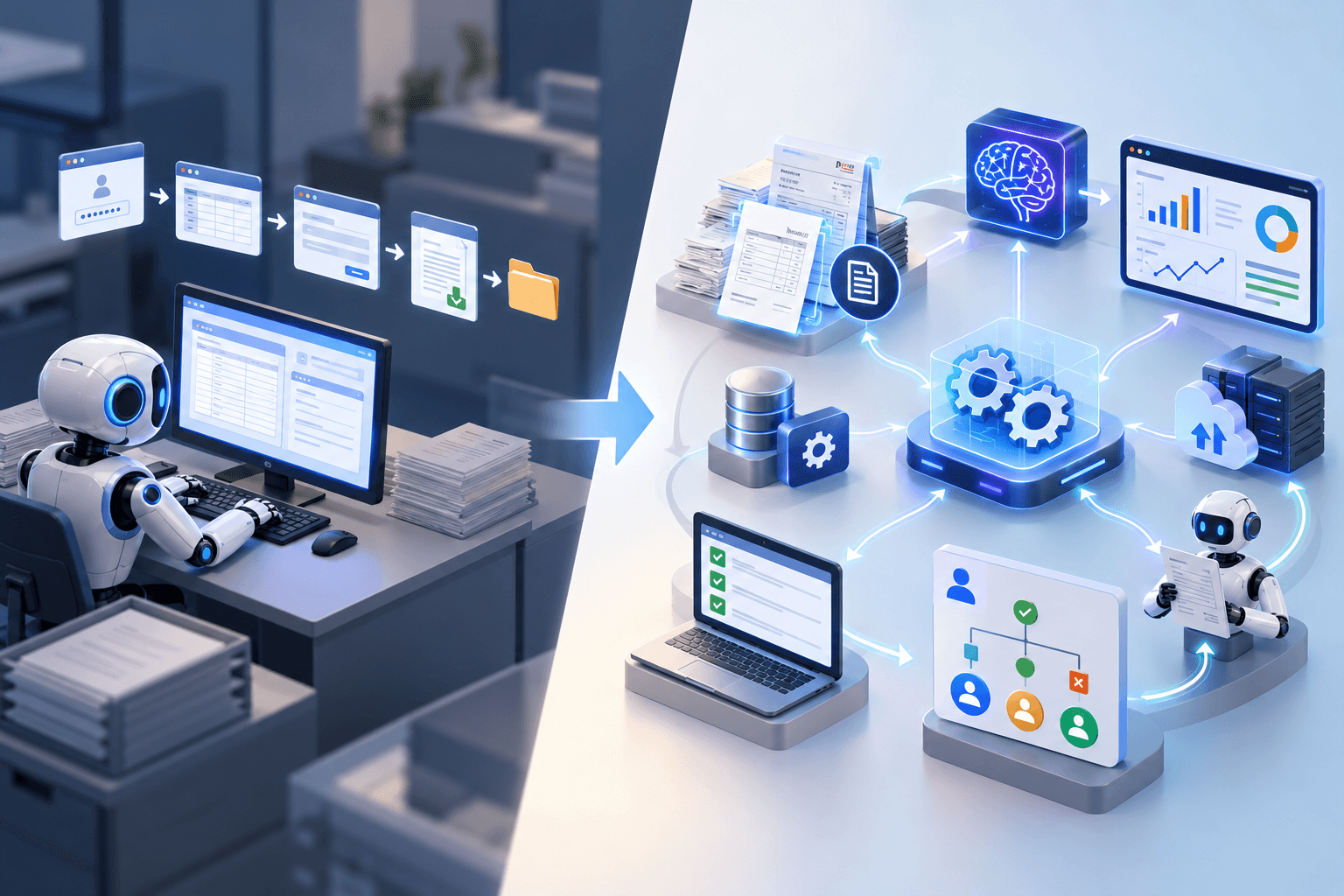
RPA automates individual tasks by having software robots copy human actions in user interfaces. Hyperautomation is a broader discipline that automates whole processes by combining RPA with process mining, document AI, APIs, workflow orchestration, AI, and governance. RPA is one tool inside hyperautomation, not an alternative to it.
If your organization already runs RPA bots, you have probably seen both sides. The bots do save time on repetitive tasks. But exceptions still go to people, bots break when a screen changes, and the process as a whole is not much faster than before. This article explains why that happens, what hyperautomation changes, and how to evolve an existing bot estate. For the full framework, see our hyperautomation guide.
What RPA Does Well
Robotic process automation is good at one specific job: reliably repeating rule-based steps in applications that people would otherwise operate by hand. Logging into a portal, copying values from one system to another, downloading reports, and filling standard forms are typical examples.
RPA's great strength is that it works without changing the underlying systems. When a legacy application has no API and replacing it is not an option, a bot can still automate the work. That made RPA attractive to business teams who could not wait for IT projects.
Where RPA Alone Falls Short
- Fragility. Bots depend on screen layouts. A redesigned web page or a new field can break them overnight.
- Unstructured input. Bots handle structured data well and struggle with free-text emails, scanned documents, or varied invoice formats.
- Exceptions. When a case does not match the rules, the bot stops and a person takes over, often with no record of why.
- Task-level thinking. Automating one step in a ten-step process saves minutes but rarely changes the overall cycle time.
- Measurement. Bot counts and "hours saved" are easy to report but hard to tie to real financial results.
None of these are defects in RPA. They are signs that a task tool is being asked to do a process-level job. Gartner made the same point when it named hyperautomation a top strategic technology trend for 2020: RPA alone is not hyperautomation.
Hyperautomation vs. RPA at a Glance
| Dimension | RPA | Hyperautomation |
|---|---|---|
| Scope | Individual tasks | End-to-end processes |
| Starting point | A task someone finds tedious | Evidence from process mining and a scored backlog |
| Core technologies | Software robots | Process mining, RPA, document AI, APIs and integration platforms, workflow engines, business rules, AI agents |
| System access | Mainly through user interfaces | APIs first, screen automation where no API exists |
| Unstructured input | Limited | Handled with intelligent document processing and language models |
| Exceptions | Hand off to a person, often informally | Designed into the workflow with routing, context, and tracking |
| Governance | Often per bot or per department | Central standards, registry, security, and value tracking |
| Success measure | Bots deployed, hours saved | Straight-through processing rate, cycle time, cost per transaction |
A Worked Example: Supplier Invoice Processing
Consider how each approach handles accounts payable.
With RPA alone, a bot opens the shared mailbox, downloads invoice PDFs, and types header fields into the ERP. Invoices in an unfamiliar layout fail. Mismatches against purchase orders go into a spreadsheet for the finance team. The bot saves keying time, but the overall time to pay barely changes.
With hyperautomation, the process looks different from end to end:
- Discovery: process mining on ERP event logs shows where invoices wait, which suppliers cause most exceptions, and how many approval variants exist.
- Capture: intelligent document processing extracts header and line-item data from varied layouts, with a confidence score per field.
- Validation: business rules perform a three-way match against the purchase order and goods receipt through ERP APIs.
- Exceptions: mismatches are routed through a workflow to the right buyer with the evidence attached. An AI agent may draft a query to the supplier for review.
- Posting: clean invoices are posted through the API. RPA is used only for a supplier portal that has no API.
- Measurement: the share of invoices processed with no human touch, cycle time, and exception reasons are tracked on a dashboard.
The bot did not disappear. It became one step in a designed process.
When RPA Alone Is Enough
Hyperautomation is not always necessary. A standalone bot is reasonable when the task is self-contained, high volume, stable, and fully rule-based, when the systems involved will not change soon, and when the surrounding process is already efficient. The mistake is not using RPA; it is using RPA as the whole strategy.
How to Evolve an Existing RPA Estate
- Inventory your bots. Record what each bot does, which systems it touches, how often it fails, who owns it, and what value it delivers.
- Retire or replace the weakest. Bots that fail often or deliver little are candidates for removal, or for replacement with an API integration.
- Mine the processes around your best bots. Find the manual steps before and after them. That is where end-to-end gains are hiding.
- Add orchestration for exceptions. Put a workflow layer around the bots so that exceptions are routed, tracked, and analyzed.
- Add document AI and agents selectively. Use them where unstructured input or judgment is the real bottleneck.
- Change what you measure. Move from bot counts to straight-through processing rate and cycle time.
Where AI Agents Fit
AI agents can handle steps that rule-based bots cannot, such as reading an ambiguous email, deciding which team should handle an exception, or summarizing a dispute. But they are less predictable than rules, so they work best inside an orchestrated workflow with clear permissions and human checkpoints.
Frequently Asked Questions
Is Hyperautomation Just RPA with AI?
No. AI is one ingredient. Hyperautomation also includes process discovery, integration, workflow orchestration, and governance, applied across whole processes.
Do I Need to Replace My RPA Platform to Adopt Hyperautomation?
Usually not. In most cases you can keep your RPA platform and add the missing layers around it, such as process mining, document processing, APIs, and orchestration.
Is RPA Still Relevant?
Yes, especially for legacy systems without APIs. Its role is narrower than it once was: one execution option among several, rather than the center of the automation strategy.
How Do You Measure the Success of Hyperautomation?
Track the straight-through processing rate, end-to-end cycle time, cost per transaction, and exception rate against a baseline measured before automation.
Evolve Your Automation with Agix
Agix International helps organizations in India and the GCC move from isolated bots to measurable, end-to-end automation. Book a consultation to review your current estate and backlog.