Cyber SecurityOctober 15, 2026
DevOps vs. DevSecOps: The Practical Differences Explained
DevOps vs. DevSecOps compared: ownership, pipeline gates, tools, metrics, and culture, plus five first steps for adding security without slowing releases.
Agix International
Agix International
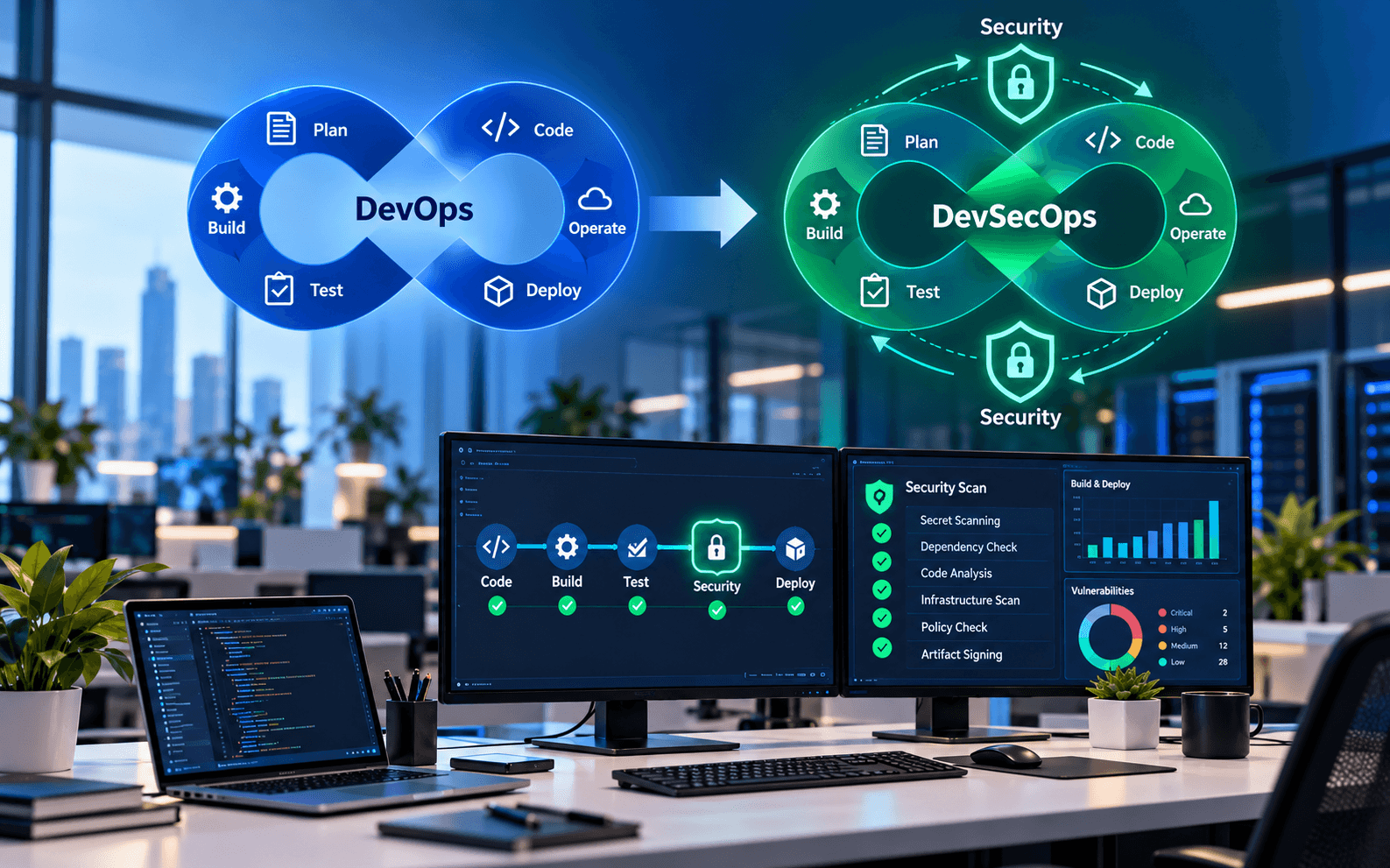
DevOps joins development and operations so teams can release software quickly and reliably. DevSecOps keeps that model and adds security as a shared, automated responsibility inside the same pipeline. The biggest change is not the tooling but who owns security: the team that writes the code also fixes its vulnerabilities.
The two terms are often used as if they were interchangeable, or as if DevSecOps were just DevOps with a scanner bolted on. Neither is accurate. This article sets out what actually changes when a DevOps team adopts DevSecOps, and how to make the move without slowing delivery. For the complete picture, see our DevSecOps guide.
What DevOps Solved, and What It Left Out
Before DevOps, developers wrote code and handed it to a separate operations team to run. Releases were slow, handoffs were painful, and outages turned into blame. DevOps fixed this with shared ownership, automation, and fast feedback. Continuous integration and continuous delivery (CI/CD) pipelines made it possible to release many times a week.
Security was often left outside that loop. A separate security team still reviewed applications late in the cycle, usually just before a major release. As release frequency rose, the review became a bottleneck that teams either waited on or worked around. DevSecOps closes that gap.
DevOps vs. DevSecOps at a Glance
| Dimension | DevOps | DevSecOps |
|---|---|---|
| Primary goal | Fast, reliable delivery | Fast, reliable, and secure delivery |
| Who owns security | Mostly a separate security team | Shared: developers, operations, and security specialists |
| When security happens | Late reviews and periodic tests | Continuously, at every pipeline stage |
| Pipeline gates | Build, test, and deploy checks | Adds secret scanning, dependency checks, code analysis, signing, and policy checks |
| Typical new tools | CI/CD, infrastructure as code, monitoring | SAST, SCA, DAST, SBOM generators, policy engines, runtime detection |
| Key metrics | Delivery measures such as deployment frequency, lead time, change failure rate, and recovery time | The same, plus time to remediate vulnerabilities, security debt, and escape rate |
| Compliance evidence | Assembled manually before audits | Produced automatically by the pipeline |
| Security team's role | Gatekeeper | Guardrail designer, coach, and escalation point |
The Five Changes That Matter
1. Ownership Moves to the Team That Ships
In DevSecOps, a vulnerability introduced by a pull request is reported to the developer who opened it, in the tool they already use, at the moment they can fix it most easily. Security engineers set the rules and handle the hard cases. They do not triage every finding.
2. The Pipeline Gains Security Gates
The pipeline gains automated checks: secret scanning before commits reach the repository, software composition analysis for third-party packages, static analysis of source code, infrastructure as code scanning, and artifact signing before release. The important decision is which checks block a release and which only warn. Block on high-confidence, high-impact findings; warn on the rest.
3. The Toolchain Expands, and Must Be Tuned
Adding tools is easy. Tuning them is the real work. A scanner that produces hundreds of low-value findings on every build trains developers to ignore it. DevSecOps teams spend time suppressing false positives, prioritizing by real-world exploitability, and removing duplicate alerts from overlapping tools.
4. Metrics Include Security Outcomes
DevOps teams track delivery performance, often using the metrics popularized by Google's DevOps Research and Assessment (DORA) program. DevSecOps keeps those and adds security outcomes: how long critical vulnerabilities stay open, how old the oldest unresolved finding is, and how many issues reach production that the pipeline should have caught. If delivery metrics get worse after security gates arrive, the gates need tuning.
5. Culture Shifts from Gatekeeping to Enablement
Many organizations appoint security champions, developers in each team who get extra training and act as the first point of contact for security questions. The central security team writes reusable policies, maintains secure templates, and helps teams fix what the pipeline finds. Security becomes a service that makes the secure path the easiest path.
Does DevSecOps Slow Down Delivery?
It can, if it is introduced badly. Turning on every scanner in blocking mode on the same day will stop releases and generate resentment. The fix is a phased rollout:
- Run checks in report-only mode and measure the noise.
- Block only on exposed secrets and critical, exploitable vulnerabilities.
- Add supply chain and policy controls once the team trusts the signals.
Done this way, security work moves earlier in the cycle, where it is cheaper, instead of adding delay at the end.
Moving from DevOps to DevSecOps: Five First Steps
- Map your current pipeline. List every stage, tool, and credential it uses.
- Remove long-lived secrets. Move credentials into a vault and use short-lived tokens for cloud access.
- Add secret scanning and dependency scanning. These give the fastest return for the least effort.
- Agree on a blocking policy. Write down which findings stop a release and how exceptions are approved.
- Name an owner for security debt. Every open finding needs a team and a target date.
Is DevSecOps Only for Large Enterprises?
No. Small teams can often adopt it more easily because they have fewer handoffs to change. Most of the first-phase tooling is open source, and a team without a dedicated security engineer can still run secret scanning, dependency checks, and basic policy gates. What small teams need most is a clear, short list of rules and the discipline to keep them.
Frequently Asked Questions
What Is the Main Difference between DevOps and DevSecOps?
DevOps focuses on fast, reliable delivery through shared ownership between development and operations. DevSecOps adds security to that shared ownership and automates security checks inside the delivery pipeline.
Is DevSecOps Replacing DevOps?
It extends DevOps rather than replacing it. The same principles of automation, collaboration, and fast feedback apply; security becomes part of them.
Do DevSecOps Teams Still Need Security Specialists?
Yes. Specialists design policies, review high-risk changes, handle incidents, and run deeper tests such as penetration testing. Their role shifts from reviewing everything to enabling teams.
What Skills Does a DevSecOps Engineer Need?
A mix of CI/CD and cloud engineering, scripting, knowledge of common vulnerabilities, familiarity with security tools, and the ability to work closely with development teams.
Make the Shift with Agix
Agix International builds cloud, DevOps, and cybersecurity foundations for growing businesses in India and the GCC. If you want to add security to your pipeline without slowing your releases, talk to our engineers.