AI & TechnologyOctober 12, 2026
The Intelligent Enterprise Stack: Agents, Automation & Data
How AI agents, hyperautomation, industrial AI, data platforms, and DevSecOps fit together into one architecture, with a worked example and design principles.
Agix International
Agix International
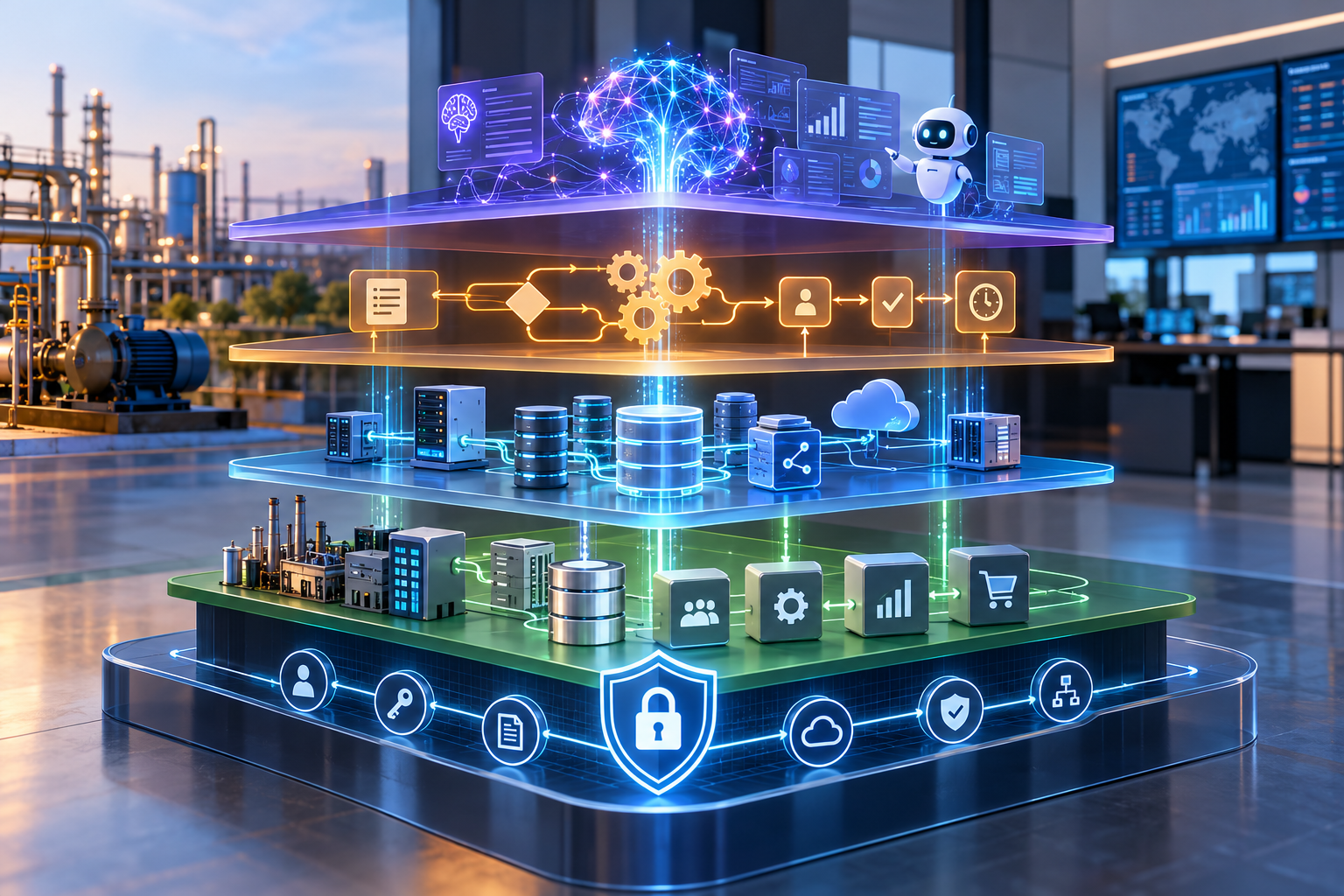
An intelligent enterprise stack is the architecture that lets AI models, AI agents, and automation act on a company's real systems safely. It has five parts: systems of record, a data and integration layer, automation and orchestration, an intelligence layer, and security and governance that run through all of them.
Enterprises rarely lack AI ideas. They lack a place to put them. A chatbot pilot here, an RPA bot there, a predictive maintenance dashboard in one plant: each works on its own, and none of them talk to each other. The result is a collection of point solutions that grows harder to maintain each year.
This article describes the architecture that connects them. It also serves as a map of our four main topic guides, on agentic AI, hyperautomation, AI predictive maintenance, and DevSecOps, and shows where each one fits.
Why a Stack, and Why Now?
AI is moving from answering questions to taking actions. In June 2025, Gartner predicted that by 2028, a third of enterprise software applications would include agentic AI, up from less than 1 percent at the time. In the same release, it predicted that over 40 percent of agentic AI projects would be canceled by the end of 2027 because of escalating costs, unclear business value, or inadequate risk controls.
Those two predictions point to the same lesson. When AI starts acting on business systems, the hard problems are integration, control, and measurement. Those are architecture problems, and they are best solved once, in a shared stack, rather than separately in every project.
The Five Layers
| Layer | What it does | Typical components |
|---|---|---|
| Systems of record | Hold the authoritative data and transactions | ERP (such as SAP), CRM, HR systems, CMMS, SCADA and historians |
| Data and integration | Move data reliably and expose capabilities to other software | APIs, integration platforms, event streams, data platforms, vector stores |
| Automation and orchestration | Run multistep processes with approvals, retries, and exceptions | Workflow and BPM engines, business rules, RPA, document processing |
| Intelligence | Predict, classify, reason, and decide | Machine learning models, large language models, AI agents |
| Security and governance (across all layers) | Control who and what can act, and prove what happened | Identity and access, secrets management, audit logs, secure delivery pipelines, policy as code |
Two points about this model matter more than the boxes.
First, systems of record stay authoritative. An AI agent should never become the place where an order or a maintenance record really lives. It reads from and writes to the systems that the business, auditors, and regulators already trust.
Second, security is not a layer on top. Every component that can act, whether a bot, an agent, or a pipeline, needs its own identity, scoped permissions, and logs.
How the Pieces Work Together: A Worked Example
Consider a hypothetical manufacturer with a fleet of critical cooling-water pumps.
- Sensing and prediction. Vibration sensors on each pump feed an anomaly detection model. The model detects a pattern consistent with early bearing wear on one pump. This is the predictive maintenance layer.
- Agent reasoning. An AI agent receives the alert. It checks the pump's maintenance history in the CMMS, looks up spare bearing stock in the ERP, and reads the production schedule to find the next low-impact window.
- Orchestrated workflow. The agent does not act alone. It drafts a maintenance work order and a parts reservation, then hands them to a workflow that requests a planner's approval. If the bearing is out of stock, the workflow raises a purchase requisition. This is hyperautomation.
- System-of-record updates. Once approved, the work order is created in SAP PM through an API, not by a bot clicking through screens.
- Governance throughout. The agent runs under its own service identity with permission to draft, not approve. Every step is logged. The code for the model, the agent, and the workflow was shipped through a pipeline with security checks. This is DevSecOps.
- Learning. When the technician closes the work order, the actual finding is recorded and becomes training data for the next version of the model.
No single technology delivers this outcome. It comes from the layers working together with clear boundaries.
Where Each Discipline Fits
Agentic AI
Agents belong in the intelligence layer, handling tasks that need judgment over unstructured information. They should call tools through well-defined interfaces, increasingly using open standards such as the Model Context Protocol, which Anthropic introduced in November 2024 for connecting AI assistants to the systems where data lives. When agents need to divide complex work, see multi-agent AI systems, and before scaling them, read why AI agents fail in production.
Hyperautomation
Hyperautomation provides the orchestration layer and the discipline for deciding what to automate. It keeps deterministic steps deterministic and limits agents to the decisions that actually need them.
AI Predictive Maintenance
Industrial AI is the intelligence layer applied to physical assets. Its value depends on the stack around it: sensor data flowing through the integration layer, and alerts flowing into maintenance systems through orchestration.
DevSecOps
DevSecOps secures how every other layer is built and changed. Models, agents, workflows, and integrations are all software, and they should all ship through the same secure pipeline.
Design Principles
- Use the least autonomy that works. Prefer a fixed workflow when the steps are known. Use an agent only where the path varies.
- API first, screen automation last. APIs are faster, easier to secure, and less fragile than RPA.
- One identity per non-human actor. Never let bots or agents share a human's account or a common admin credential.
- Human approval for consequential actions. Payments, safety-related changes, and customer commitments need a checkpoint until performance is proven.
- Observability by default. Trace what each agent and workflow did, with which data, and why.
- Data contracts between layers. Agree on formats, ownership, and quality expectations so one team's change does not silently break another's automation.
Common Mistakes
- Building each AI use case on its own integration and security setup.
- Giving agents broad administrator access "for the pilot" and never removing it.
- Treating dashboards as the outcome, when the outcome is an action taken in a system of record.
- Skipping measurement, so no one can say which automations pay for themselves.
- Choosing a platform first and the processes second.
Where to Start
Pick one end-to-end process that crosses at least two systems and has a measurable cost, such as invoice processing, maintenance planning, or customer case resolution. Build it across all five layers, with security and measurement in place from day one. The connectors, identities, logging, and pipeline you build for that first process become the shared foundation for the next ten.
Frequently Asked Questions
What Is an Intelligent Enterprise?
It is an organization that uses data, AI, and automation to make and carry out decisions across its operations, with the integration and controls needed to do so safely.
Do AI Agents Replace Existing Enterprise Systems?
No. Agents work on top of ERP, CRM, and operational systems. The systems of record remain the authoritative source of data and transactions.
How Do AI Agents and RPA Work Together?
Agents handle steps that need judgment, such as reading an unusual email or deciding which case to escalate. RPA and APIs carry out the deterministic steps. An orchestration layer coordinates both.
What Should a Company Build First?
Start with a single high-value process and build the integration, identity, logging, and pipeline foundations properly. Those foundations make every later project faster.
Build Your Stack with Agix
Agix International designs and builds custom software, AI systems, cloud and DevOps foundations, data platforms, cybersecurity programs, and enterprise systems for companies in India and the GCC. If you want to connect your AI and automation projects into one architecture, schedule a consultation.